Monday, August 7, 2017

Pioneer N-50 digital transport vs Cambridge CXC review 2017

A computer is an amazing jack of all trades. You can send an email, or make a spreadsheet, do some typing / word processing, watch a YouTube video, and surf the net, and buy some stuff online. Yay! You can even listen to music on your computer! Well, of course you can duh! Because if you've read my blog you will have seen a review of the Yellowtec PUC compared to the Audiophilleo, and seen my comment about Small Player audio software.

These days computers are a ubiquitous household item, and as such people have a natural tendency to want to use the tools which are at their disposal. Even though I have spent a few years playing back music directly from my PC it wasn't personally giving me the sort of sound I really wanted, because I'd  heard CD players which I knew sounded much better than my PC. It also doesn't aesthetically or psychologically do much for me to have a PC in the audio rack in the lounge room. Although I concede that other people may not share this view.

Playing back audio from a computer has its own set of problems, which is that every playback software has its own sonic signature, and thats OK, except for that no playback software in my experience ever manages to sound quite right, and of course you need a way to get audio from your HDD into your stereo system, and that usually involves either a PCI/e sound card or a USB to
SPDIF converter or a USB DAC. Because the PC is a jack-of-all-trades, its not designed specifically for audio. PCs use a jack-of-all-trades operating system that need to do all sorts of things that you don't need for it to do to play audio. The motherboards have various switching regulators generating lots of high frequency noise which gets into the audio side of things and that's a no no for good quality sound. Of course you can use USB isolators and various ad-on thingies, and you may indeed get a better sound than you got without them, but in my opinion still it leaves something to be desired, primarily a lack of low level detail. Well, that's what I've found anyway!

Fist lets talk about the Cambridge CXC CD transport. When I bought this transport the first thing I did was play some orchestral music because it allows me to hear how well a piece of equipment is revealing low level details and tonal accuracy. The Cambridge CXC does a fantastic job of revealing low level details, even the quietest sounds can be easily understood and identified, which is something that no PC soundcard or USB converter I've tried could do properly!
The Cambridge easily sounded better than the PUC2 converter ( though I admit I am going by memory) but though the PUC2 was good, it didn't let me hear the low level details that the Cambridge CXC allowed me to hear. The CD transport just gives more of everything! More detail, more depth, more believable sound, but, even though I lived with it for a few months and loved it, I found that it was tonally a bit bright. I knew there had to be a better transport out there.

I'd been looking at the Pioneer N-50 since it was first released in 2012, but when it was new it cost a little more than I wanted to pay at the time, and so I had to wait until they were being sold at clearance pricing before I bought one. So, actually at the time of writing this article (2017) the N-50 has been superseded with a newer model with a larger screen, and a different DAC chip, but to the best of my knowledge, the digital transport section should be the same. For the purpose of this review, I am only discussing the N-50 when used as a transport feeding my stand alone Burr Brown R2R DAC.

The N-50 is the the best digital transport I've personally heard. 

I did some back and forth switching with the Cambridge CXC and found that the CXC would present the sound with a lot of attack and emphasis to the leading edge of notes, but when switching to the N-50 I discovered that the same tracks actually don't have that sort of attack and actually sound quite smooth. For example I found the CXC to present high hats in a loud and more "digital" harsh sounding way. The N-50 presents high hats quieter and more naturally. With the N50,  midrange sounds (such as vocals) are slightly more forward, but also have more subtlety and body.  I was pleasantly surprised to find that CDs pressed in the mid 1980's which in my experience often sound a bit thin, when ripped to my NAS and played back on the N-50 actually sound very nice and no longer have a steely sheen or harshness to the sound, and they actually have bass! The N-50 also allows very long listening sessions without fatigue. When I listened to Talking Heads - Little Creatures album (UK pressing, Nimubs mastering) I found that it sounded very dynamic and exciting on the CXC but wow the snare drums could take your head off! The same album on the N-50 is actually quite smooth sounding, the snare having body, but no unnecessary attack or brightness. Album after album is like this. Female vocals which previously had unnatural sibilance on every other transport have none on the N-50. The N-50 has an absence of grain across the entire audio spectrum which is also very pleasantly noticeable and this increases perceived detail.

After a fair amount of listening I suppose that the differences I'm hearing can probably be attributed to very low jitter from the N-50.

Pioneer says in their brochure that the N50 has a "High-Accuracy Master Clock". I think this is a very understated way of saying it has an extremely low jitter clock of the highest quality. Other manufacturers would be making a big deal about this, and Pioneer has probably in my opinion missed a major opportunity to discuss some obviously excellent engineering, but it seems that its not the way Pioneer does its marketing.

Due to the N-50 I believe I have been able to experience the effects of low jitter and I can now describe them.
High jitter transports do the following;
  • emphasise sibilance
  • emphasise the leading edges of notes
  • emphasise high frequency sounds causing "brightness"
  • change the tone of instruments and vocals
  • makes music sound "digital" and a bit fatiguing.
  • bury details.

Low jitter transports sound;
  • Natural
  • Balanced 
  • Do not emphasise leading edges 
  • Make listening relaxing 
  • Tonally correct
  • Detailed without drawing unnecessary attention

In closing one thing I'd like to say is that I was surprised to see that out of the 5 or so professional (commercial) reviews of the Pioneer N-50 which can be found on the Internet, not one of those reviewers chose to listen to it as a transport feeding an external DAC, and as such those reviewers missed precisely what this device does best, which is being used as an ultra low jitter digital transport!

Sources that I previously thought were very good, have dropped far down on my list of goodness.
The Pioneer N-50 is now my most highly regarded transport.


Saturday, September 10, 2016

Cerwin Vega XLS-215 Review 2016

I've owned my Cerwin Vega XLS-215 speakers for over 5 years, so I am very qualified to comment upon their sound.

The Cerwin Vega XLS-215 is a physically large and imposing speaker. It uses two 15" woofers, a 6" midrange and a horn loaded silk dome tweeter. With their black veneer and red speaker surrounds and CV logo on the dustcaps they will visually dominate your listening room.   If you own a pair, everyone who visits your house will make remarks about the size of these speakers, irrespective if they are audio enthusiasts or just friends and family.

Before I describe their sound I want to  make an observation about many current "Hi Fi" Audiophile type speakers you will find in your local HiFi shop. Almost all modern hifi speakers are thin towers with small woofers. When these speakers try to reproduce bass, most of the time they sound congested when trying to do so, and there is certainly no impact even if they manage to do it! My other observation is that even though they will certainly have some redeeming feature to their sound which is usually the midrange and high frequencies, I find that often after a few minutes, most of these modern "hifi" speakers sound fatiguing because they have a forced unnatural detail in the midrange. Immediately when I listen to them they sound pretty good, but soon I can hear a sound which is too forward, and frankly to me sounds unnatural and incorrect.

That was my segway into discussing the XLS-215 and I will start by mentioning the midrange. The XLS-215  produces nicely detailed almost liquid like sound which integrates seamlessly with the high frequencies. There is nothing fatiguing about the midrange or high frequencies. The 6" midrange cone is of adequate size to reproduce low enough notes to blend with the 15" woofers. Though this transition is not quite as seamless as the mid - high transition but is still very silky.

I'm sure there are a few brand snobs who wont even consider Cerwin Vega. Well, that is their loss. 
The XLS-215 does almost everything a person could want from a full range speaker. By full range I mean that the speaker plays the full range of audible frequencies, from 30Hz to 20Khz. This speaker also plays frequencies proportionately, with bass having a strong thump down low when requied but also being smooth through the mids and gentle in the highs.  If you haven't already gotten the idea of the sound I feel it necessary to stress that its sound is actually very contrary to its appearance. By looking at it you might think a few things such as that it might sound boomy in the bass, or that it has an aggressive harsh sounding high frequency horn, or that it is all "boom and tiz", but that is completely wrong!  As the saying goes, never judge a book by its cover! This speaker is almost the opposite of what you think it is. Its overall character is smooth, clear, balanced and relaxing to listen to. Fortunately you wont need to turn up the volume to get the speaker to come alive. Its high sensitivity drivers allow listening at low volume with plenty of authoritative tonally rich bass and a seductive smooth and detailed midrange, and silky smooth highs. Yes that's a stereotypical reviewers comment which I deliberately threw in there as humor, however in this case it really is true!  You wont need a powerful amp to drive these speakers. As I've been writing this review I have been listening to my XLS-215 using a 10 Watt amp I purchased from ebay. It drives these speakers to 90 + dB with ease.
I've previously owned an Emotiva XPA-2 amplifier (which output about 500 Watts per channel @ 4 ohms) and used it to power these speakers. (incidentally I do not recommend the Emotiva amp due to hum and buzz noise issues I had with it). So potential purchasers should not be scared off by thinking they need a powerful amp to drive these speakers. I have also successfully used these speakers with an 8 Watt single ended triode valve amplifier.

So is it the perfect speaker?
Well, I've yet to hear a perfect speaker, but this one comes very close!

What are its weaknesses?
In comparison to other expensive speakers I have heard, I would say there are not many weaknesses. I have compared these speakers to JBL S4700, and B&W 803, and frankly the Cerwin Vega XLS-215 sounds better to my ears, for the following reasons- the XLS-215 has a greater bandwidth (plays lower) than both the B&W and JBL, which means to me it is more immersive and correct sounding and has the correct scale to bass sounds. The midrange is a little bit more detailed on both the JBL and B&W, but both those speakers sound fatiguing and I would personally much rather a little less detail so as long as the speaker is relaxing to listen to. Of course I respect that others may have a different view. But I'm writing this review from my point of view. One other minor weakness is that occasionally I can hear the sound of the waveguide on the mid and tweeter. This gives a slightly plasticy sound to the midrange on some notes. But I need to stress that it is not obvious at all times and only happens sometimes. I should also say that I am generally not a fan of horn speakers, but the horn, AKA waveguide on the XLS-215 is very shallow and gentle on the midrange, and strangely not very audible in the high frequencies on this particular speaker which is interesting. But having said that, it is a different sort of sound when compared to a flush mounted midrange and dome tweeter. Generally I would say that a flush mounted mid and tweeter sounds more correct and natural than any horn. But nobody is making large speakers with flush mounted mids and tweeters so its a moot point.

If I had a million dollars would I still buy these speakers?
Well, since I already own them I think its safe to say I would certainly keep them because I am very happy with them.When compared to other speakers at their price point there is nothing else that even comes close. Even if you increase the price range to$15,000 there are a few options such as the JBL S4700. But when we consider that the Cerwin Vega costs only AUD $2600 per pair, its pretty good value.

Final Note.

The midrange driver uses a fabric accordion surround which takes ages to run in, meaning the surround takes ages to loosen up. When new, the midrange sounds quite recessed and not detailed. Anyone evaluating these speakers in a shop needs to be mindful of this if they are not run in.
The woofers also need a bit of time to run in.

It should be obvious to any intelligent person that there are different speakers made for different listening preferences. There is no such thing as a perfect speaker for all people and all rooms. The XLS-215 is made for people who enjoy high fidelity, full range audio, and who want to enjoy the bold dynamics of a large high sensitivity speaker, and who want to have bass frequencies which project and couple well to a large room. If you have read this article you are probably the sort of person who will enjoy these speakers.


Addendum:

For anyone who might have seen a video on YouTube comparing these speakers to a pair of Klipsch speakers, you might come away with the impression that the Klipsch sound clearer. I'd like to point out a flaw with the audio of that video.  The microphone used to record the sound on that video was not capable of handling the high sound pressure levels at low frequencies produced by the Cerwin Vega XLS-215. As a result, the sound was distorted when the CV speakers are playing on that video, resulting in the CV mid/high frequencies being modulated with the low frequencies. I find YouTube videos to be a very useful resource, but in the case of that particular video, be aware that the distorting audio does not provide a fair comparison. There are other videos on YouTube which show the XLS-215 speakers playing which provide a fairer demonstration of their capabilties.


Monday, October 26, 2015

The award for best PC audio playback software of 2015 goes to.....

Many readers will know that previously I have spoken highly of players such as CMP and MQN.

Both are excellent players.

But my new favorite player is Small player

I previously thought that MQN was the best sounding player because it is dynamic but still smooth and lacking in harshness. But now that I have heard Small player I have had to re-evaluate. What I like about Small player is that it has an extremely grain-free sound which gives a perception of greater depth and detail to the music. Edges of notes are very defined. Attack is crisp. The overall sound is nimble, and layered. The high frequencies are incredibly crisp and clean. In comparison MQN sounds slow and plodding. (Note; in all fairness there are about 50 different ways you can configure MQN and my comments relate to the version I am running)

Small player is programmed in Assembly which is one form of code above machine code.
Assembly takes longer to program but is very efficient. Software programmed in C (for example) has more lines of code and is not as efficient. Simply put, C gets converted into Assembly, and in the conversion process, lots of lines of Assembly code are created, making the software bloated.

I suspect one of the reasons Small player sounds so good is its efficient use of code.

Unbelievably this software has been around since 2005 and appears to have received very little recognition among the computer audiophile crowd. I hope this now changes!

Thanks to Igor Jerosimić for writing such a wonderful audio player!


I have been running Small player on Windows Server 2012 with Fidelizer into a USB SPDIF converter and DAC. But it also sounds excellent on my laptop without any Fidelizing.
 

Small player wins my award for Audio playback software of 2015.


Thursday, September 3, 2015

Audio Technica AT150MLX vs Ortofon 2M Black review

This review was conducted with the AT150MLX fitted to a Kenwood KD500 with SME 3009 Series 3 tonearm. The 2M Black was fitted to a Linn Sondek with Origin Live Encounter tonearm. Although I would very much have liked to have compared the cartridges on the same turntable and tonearm, neither the Origin live or the SME has a detachable headshell and so swapping cartridges would have added too much time between listening sessions. The review was conducted by listening to one or more tracks on one turntable then immediately listening to the same track or tracks on the other turntable. Please take what you want from this review.

Despite these turntables being very different, the sound coming from both decks in the same system using the same phono preamp was incredibly similar. I wasn't expecting a Kenwood to sound so similar to a Linn, but they did! From this I have learned that a good turntable is a good turntable irrespective of its reputation, recommendation on a forum, its mystique, cult status or lack of. I always recommend people to come to their own conclusions by trying equipment before making a judgement.

 The sound coming from both turntables was well balanced. Neither cartridge sounded bright, or boomy and I was surprised to find that the sonic balance was near identical but I will attempt to describe some of the differences below.

There are some notable differences between the AT150MLX and the Ortofon 2M Black. The AT150MLX uses a gold plated boron cantilever with nude Microline stylus. The 2M Black uses an aluminum cantilever with nude shibata stylus.
The difference between these two stylus is that the shibata has a wider radius and does not sit as far down in the groove as the microline stylus which sits very deep in the groove. Audio Technica says the microline is very close to the shape of the cutting stylus used to cut records. Shibata cut was developed in the 1970's to allow the cartridge to reproduce the very high frequency carrier signals on quadraphonic records. Both microline and shibata stylus profiles provide a large contact area with the sides of the record groove which reduces pressure on the groove, and simultaneously reduces wear on the stylus. Both profiles are superior to a regular eliptical stylus in this regard. Both profiles are excellent at cleanly reproducing high frequency sounds from records.

Differences that I observed between the two cartridges are that the 2M black has slightly softer more silky and rounder sounding high frequencies. The AT150MLX has very fast and crisp sounding high frequencies. Tonally there is a slightly warm tinge to the 2M Black. The AT150MLX sounds slightly cooler and leaner. However I must stress that the difference in tonally is quite small and in the grand scheme of things is quite unimportant. Effectively both cartridges have an extremely similar sonic signature.

But differences there are, and if I was to be ultra picky, I can fault with both cartridges, though neither fault is a deal breaker, and in isolation without doing an AB comparison its unlikely that anyone would be picky about the sound that comes from either. However what I observed is this;
The 2M Black sounds a bit slow, warm and rounded. The AT150MLX can sound sharper faster meaning that the leading edge of sounds can appear somewhat highlighted, and this applies to the entire frequency spectrum.
But I have to stress that neither present the sound as obviously wrong or incorrect. But after doing the AB comparison I thought to myslef - wouldn't it be nice if I could have the speed of the AT150MLX, and the slightly warm presentation of the 2M Black. If I could have a hybrid of the two cartridges I think id be very happy.

In summary;

The 2M Black provides truly excellent sound. Its forte is its ability to provide a highly detailed and easy to listen to tonal spectrum where everything is well balanced but slightly on the rose coloured side of neutral, and this sound will suit many people.

In comparison, the AT150MLX also provides equally excellent sound its microline stylus providing slightly sharper edges of notes, with very noticeable improvement in speed and accuracy in the  high frequencies, and this speed and accuracy flows through to the rest of the audio spectrum.

There is one final noticeable difference between these two cartridges which is the ability of the microline stylus of the 150MLX to sit below the groove wear resulting in a very noticeable reduction in surface noise compared to the shibata stylus of the the 2M Black which sits higher in the groove.

I think it should be obvious that I favor the AT150MLX. I honestly think it is the more accurate of these two cartridges. But the 2M Black is just so easy to listen to, whereas the AT is always presenting so much speed that its always begging the listener to sit up and listen. Whereas the 2M Black has a certain balance of fine detail and ease with its presentation.

Lucky for those who want a new moving magnet cartridge, we have two excellent cartridges in an affordable price range.

For those who prefer fast leading edges of notes and don't like a rose coloured presentation then the AT150MLX is for you.

For those who prefer excellent levels of detail with a very coherent relaxing and musical experience the 2M Black is for you.

But so similar are these cartridges that assuming correct set up (and cartridge loading) I honestly believe that any discerning listener could live with either cartridge. They are both excellent.

The AT150MLX can be purchased for around AUD $400 and the 2M Black costs about double at
AUD $800

So based only on price I would declare the winner to be the AT150MLX.
If based on listening, then its a very tough call, and I would say that it comes down to personal preference, and system matching. In that regard I will declare it a tie.


Sunday, August 16, 2015

Coral 12SA-1 speaker kit user manual


I have included the Coral 12SA-1 speaker kit builders manual here for peoples reference.
The Coral 12SA-1 is a very nice sounding speaker.
I hope this information is helpful.


Sunday, August 2, 2015

Reel to Reel tape - Pop a vein? No - Pop Pavanne

I have been listening to a few Reel to Reel tapes. (They sound fantastic.)

I thought I would post this one here because it seems to be rare. There is no mention of it on Discogs, or anywhere else I have found. 
The artist is The new Elizabethans, the title of the album is Pop Pavanne. I suspect the music was recorded somewhere around 1967-1969 based on the only other recording by this group that I know of.
The reel runs at 7 1/2" per second. This one is in mint condition and has no tape stretch or drop outs!
Astor AST314 is the catalog number. 

The style of music I would describe as 1960's orchestral. I guess the band is called  The new Elizabethans because they use harpsichord in most of the tracks. There is also bass guitar, acoustic guitar, castanets, bells, tambourines, flute, trumpet and more. The album incorporates many styles but is a sort of cross between classical harpsichord crossed with flamenco guitar, and easy listening lounge music.
I like it! 


Wednesday, January 28, 2015

Vinyl and Digital sound

Vinyl vs Digital.


Why do people get so emotional when discussing these two formats?

Speaking for myself I certainly was very peeved in the 1990's when some LP's I wanted to buy were not available (locally anyway) and I had to buy the CD.

Back then I listened to all my music on vinyl. I was used to the sound, and I found the sound of CD to have a harsh and unnatural top end, and a glassy harsh and unnatural presentation to the sound. I was using a Marantz CD-40 with the famous TDA1541A.

After many years of searching I eventually found a CD player which was relatively pleasing to my ears. Strangely it was a vintage unit -The Akai CD-A7 with a Burr brown PCM53.
It was the first CD player that I found to have bass that was reminiscent of a vinyl LP, and a top end that was reasonably gentle on the ear. The unit had a substantial weight due to the two huge circuit boards and wires that ran between each board. Quite unlike new CD players that often have only one small board, and one chip to control the CD drive and another one or two chips to do the DA conversion.

This was a turning point for me. Finally I could listen to CD without being grossly offended. I purchased many CD's after this point, but still continued to listen to vinyl. I should mention that despite finding this inoffensive CD player, I still preferred the sound quality of vinyl.

Since my CD collection had grown, and tastes in the music I listened to had changed, I found myself listening less and less to vinyl. My record player had become old and my stylus was worn. I retired my record collection, and exclusively listened to CD or music ripped losslessly to my computer, and played back on my DAC.

I've owned many DAC's, and after going through quite a lot of them trying to find the right sound, I finally came back to the the TDA1541A in non oversampling mode. I use a now discontinued kit DAC which was made by HiFi DIY with a 6922 valve output stage. This DAC is really nice to listen to. It provides deep bass, ultra clear midrange, gentle highs and a warmish / un-digital presentation. When comparing it to other DAC's this one has everything the others have but with greater frequency extension and greater tonality to the sound. I have heard DAC's with a clearer top end, but their overall presentation is not as conducive to long listening sessions - in other words I get fatigued with these DAC's and end up swapping them out for my NOS TDA1541A.


I recently got back into vinyl. I bought a number of record players and some new old stock cartridges. I also bought a little bear phono preamp. I never sold my records, and have recently bought over 200 used records from op-shops. I've washed them, and listened to a few of them.

Being a continuous waveform, analog has a certain sound. The audio is not sampled many times a second then reconstructed for listening, basically what went into the microphone is what you get out of your speakers. When you have a record in good condition, the music comes out like silk - Its very easy on the ear. When I exclusively listen to CD or digital files, I get used to the sound. When I listen to vinyl after listening to CD, the analog sound its obvious, it's so smooth and organic and natural.
Going back to CD sounds clunky, brittle and harsh.


Friday, January 16, 2015

Project Genie Review

On review today is the Project Genie. Priced at AUD $429.

Straight to it. I fitted this turntable with a new old stock Nagaoka XXXXX (edited)  cartridge which comes with a shibata stylus.  I've listened to this cartridge on a few different turntables and it really is an excellent cartridge. The cartridge motor is a 1970's design, but really who cares? Some of the most highly acclaimed cartridges come from the 1970's - Grace, Shure etc. Being old doesn't mean bad or obsolete!
People in the 1970's could still hear up to 20khz and amplifiers were able to reproduce the full range of frequencies with suitable detail.

OK, the sound. Compared to a variety of 1970's and early 1980's "affordable" turntables that I have in my collection, what can I say about the build quality?

The main bearing is very good. It uses an inverted bearing with  stainless steel center, and a ball bearing contact surface. Rumble and platter rotational noise is very low. Good!

The tonearm is not that great. Being an S shaped arm its static balance is off, and since there is no weight to correct for this static balance issue, that is a bad thing, though only a few 1970's tonearm manufacturers did actually provide this weight, most don't. Is it necessary? Yes!

The tonearm bearing also has a lot of play in its vertical bearing. The tonearm can physically be pulled up and down. The horizontal bearing seems fine.

The stock mat that comes with the Genie is a dog. It sounds really bad. The material is too soft and can be folded in half easily. This turntable doesn't like a soft mat. I tried a few mats and ended up with a firm felt mat that I have owned for many years. This mat makes the sound much more dynamic, and makes everything clearer from treble to bass.

The sound of the Genie is a dark sound. Bass is fairly strong, but not particularly tonally rich. Treble is rather soft. In my opinion the treble of a vinyl record is one of LP's stronger points when compared to digital. The sound stage is rather limited. The sound is tight and controlled, but in my opinion too tight and controlled. To me the sound is reminiscent of the original Rega Planar with the glass platter, and in some respects that isn't too bad a thing. I admit that I have a preference for the sound of suspended chassis turntables like Thorens and Linn, and a variety of "affordable" 1970's  turntables with suspended chassis. I find that the suspension gives a "musicality" that non suspended turntables often dont have. When I say musicality, I dont mean resonance, distortion, bloated bass or anything like that, I mean, they sound musical and enjoying to listen to, with clarity, rhythm,  "swing" and dynamics to the sound. The Genie, sounds very much like an "average" CD player, and this is the problem.
If someone wants to hear vinyl at its best, they need a musical deck. As far as I'm concerned the Genie, does not exceed the sound of an average CD player in terms of dynamics, musicality, sound-stage or detail. The sound is rather flat and closed. My missus walked into the room looked at the Genie, and commenting about the sound said "I thought that was a CD"

In its favour: good quiet main bearing.
Against:
Flat and un-dynamic sound.
Plastic sounding - due to the material used to make the platter and also probably the tonearm.

The Genie is a competent deck, but I've heard so many affordable used "vintage" decks that can be bought on ebay for far less than the Genie. I'm talking 1970's Pioneer or Pioneer style decks that can be had for around $150 - $250 that can annihilate the Gennie in terms of musical enjoyment, that i cant really recommend this deck even as an entry level model.

So who might this deck suit?
Well considering the belt needs to be manually switched between 33 1/3 RPM and 45 RPM, the power switch is in an awkward position. When swapping cartridges, the tracking weight is adjusted by operating a hex head screw on the weight and requires fiddling for far too long trying to get the weight just right - Its neither easy to set up, doesnt have a dust cover, and it also has limited "tweaking" potential.

Basically what you buy is what you get. Its neither a "tweaker" and "upgraders" deck, nor is it awesome "out of the box" so , really, if you are looking for a "cool" and different looking turntable perhaps this is for you, but otherwise, I'd rather spend my $429 elsewhere. It just doesn't have any special quality for me to give it any particular recommendation whatsoever. Even if I needed to save up for a long time to be able to afford this, I would much rather keep on saving until I reached $1,000 and then buy something with much more going for it, or buy  a vintage deck with a half decent reputation for lesser money!

Final thoughts: 
Perhaps this cartridge isn't the best match for this deck. Considering this deck has a tendency for flat sound perhaps an Audio Technica cartridge with a more "in your face" dynamic and vibrant sound would be a better match. Such as the AT95 E or AT3400 E etc. After further fine tweaking of cartridge VTA, I did manage to get a more satisfying sound out of it, although my earlier comments still stand.

If we purely think of this in terms of where it sits in the market place of new turntables its a cleverly priced unit that has sound commensurate with its price. Its probably better than Project's cheaper decks, and not quite as good as turntables that are double its price. So in terms of market positioning its pretty spot-on.

Its competent, but in my opinion its not a great deck.

Wednesday, January 14, 2015

Little Bear T10 phono stage vs Rod Elliott PO6 phono stage

Well, I usually write about digital, but why not write about analog?

Analog sounds awesome, vibrant, and natural. It has certain bass, midrange and high frequency qualities that digital does not seem to be able to reproduce. I wont say one is better than the other. Both are enjoyable in their own way. Both have advantages and disadvantages.

On review today is the Rod Elliot PO6 op-amp phono stage and the Little Bear valve phono stage.
Both are DIY kits, the Little Bear comes fully assembled, and the P06 requires assembly.


Of the two kits, the most DIY friendly is the P06, after soldering, it just works. It is silent, and it accurately goes about its business of applying the inverse RIAA curve and amplifying the small signals from your turntable.

The P06 is a very neutral sounding phono stage. This actually goes in it favor. It does not over emphasise any frequency, and gives a very tidy and clean presentation to the sound. If there is a quiet passage, its quiet, and if there is a dynamic passage the sound jumps out. It doesn't sound restrained, it provides good high frequency reproduction, and the bass well extended, tidy, clean, and clear.
Its probably like an excercise in technical perfection. If you check out Rod Elliots site you will see the engineering effort that went into it. Rod seems to be a straight down the line kind of guy, calling a spade a spade. He has a very technical approach to audio, designing his gear to achieve low noise and a flat frequency response (or in this case, an accurate inverse RIAA curve), and really, what more do you need?

The P06 sounds great!

The Little Bear phono stage comes from China and can be ordered from eBay or Aliexpress.
I know nothing about its designer, or the engineering philosophy. I have created an  RIAA curve using software and checked the performance of the Little Bear. It was close enough for me to give it the thumbs up. I'd say it was designed to provide an accurate inverse RIAA curve.

Straight out of its cardboard box the Little bear is a big disappointment. It's 100Hz noise is terrible, but, through that noise it is possible to hear the potential.  Now I just needed to fix that noise!

The high gain required for a phono stage, along with un-sheilded valves results in the valve picking up every bit of noise from the ether that it possibly can, including transformer radiated noise, and noise from the mains wiring in the house.

The solution was to put it into a metal box. Problem solved (- well, almost see far below) Now I could get on with listening to some music.

The Little Bear is a vibrant sounding unit. The valves seem to be giving that extra bit of "valvey" goodness. The mid range is luscious and forward, the bass is very strong and tonally rich, and highs explode from the speakers in a smooth and satisfying way, and despite the forward sound there is never  any harshness to mention. There is also a great deal of clarity, but not quite as much as the P06.

On review here today are two excellent phono stages which come from opposite ends of the spectrum - the technically perfect P06, and the problematic humming Little Bear.

Both offer a sound which presents analog at its best. If you are able to assemble a kit without killing yourself or blowing something up, It really comes down to a choice between, valve sound, and solid state sound.

Op-Amps are technically perfect, and go about their business quietly and correctly. Valves are always "boiling off" electrons,  always vibrant, glowing in their box (even if you can't see them) and will eventually wear out, -a  very natural and organic trait, and perhaps this is what is reflected in their sound.

The P06 gives a slightly cleaner and more pin-point sound. Notes start and stop very cleanly. The Little Bear is more gentle in its starting and stopping, but when an instrument jumps out, it really jumps out with a vivacious lust to be heard.
 
Taking into consideration that an off the shelf "reasonable" phono preamp you can buy in a shop tends to start around the $150 mark for something quite basic, and the next step up is around $250-300. For this sort of money, you can try both the P06, and the Little bear.

You probably want to know which one is my favorite -  It was the Little Bear for quite a while, but now is the P06!. 
Sound is very personal and subjective and I like the vivacious presentation that the Little Bear provides, but after a couple of years, I now much prefer the P06 for a few reasons.
I can't completly eliminate the hum from the Little Bear, and hum really is very distracting. Nobody wants hum in their audio. After doing some AB comparisions with classical music its pretty obvious to me that the P06 has far more detail, and accurate tone. The Little bear is "nice" sounding. The P06 is more accurate, has much lower noise, and gives me more long term satisfaction.

The P06 gets my highest recommendation for people who want excellent sound. Its amazing budget price, and low voltage for safety is icing on the cake. I give it 10/10 for sound. 10/10 for price. Perfect! I'd like to point out that I've never before thought that something was good enough to rate it a perfect 10, so this is very high praise from me.

It may be too much work for the casual DIY person to get the Little bear into a case and sounding good? The P06 appeals to my electronics engineering background, for  - its excellent engineering, low noise, and it works out-of-the-box! The Little bear appeals to my "musical" side because it is a bit more "fun" and "musical" to listen to, but the hum that refuses to go away is a problem for me. I have to take points off it for that. If it didn't hum, I'd score it a 9/10. With the hum reduction techniques I employed i'll give it a 7/10. As supplied from ebay - without case and humming as it did, I'd give it a 5/10 becuase hum totally wrecks your listening experince. Hum has no place in a modern audio system. Don't hope or think or assume the hum is fixed. Don't assume you wont get some hum. Depending upon your skills, it can reward you or can annoy you. Think very carefully before buying the Little Bear.

Some people may be wondering if the valves give a "colouration" to the sound. I don't believe that they do. I believe that the difference in sound is simply due to the technology used. Valve or transistor. Each has its own sonic signature. Valve guys might say that op-amps give a colouration to the sound. Both opinions are probably correct. But the op-amp has far lower distortion and gives a more truthful insight into whats on the recording.

When the Little Bear was first sold a few years ago, with the high Australian dollar, and lower overall price, it was worth a try. These days the price has gone up, and I no longer think it is the bargain it used to be. For someone wanting a top notch phono stage, the DIY P06 phono stage is a no brainer.
It will give higher sound quality at half the price of the Little Bear.

Below a spectral content shots of the same song recorded on the Little Bear (top) and the P06 (bottom) Also please note the Little bear has a hotter output than the P06 and this may have affected the colours in the spectral content. The audio recording was made at 88.2Khz 16bit to capture any high frequencies present on the LP.


Thursday, November 27, 2014

There are two theories with regard to digital audio

Basically there are two theories with regard to digital audio.

1) Bit perfect transports all sounds the same.
2) There are many bit perfect transports but some sound better than others.

If you are a subscriber to #1 then everybody else is wrong or their gear is broken.

If you are a subscriber to #2 then you don't understand why subscribers to #1 cant hear it!

Thursday, October 9, 2014

What amp to choose for my Audioline speakers?


Amps are difficult to choose. These days options are limited when going into a store and hoping to find a two channel amplifier, that is affordable and of good sound quality, and reasonable power.

In order to give an example of what not to choose -
My Sherwood home theatre 5.1 amp (which I purchased very cheaply from Cash converters- just to try out the surround sound thing)  is rated at 100 Watts per channel. It says so in the user manual. The amp weighs about 6kg. ( that says it all)

When I connected it to my Audioline AL-1400, AL-600 or AL-3210 speakers they just sound lifeless and completely flat.
Well - its not the speakers! It's the darn amp. That amp just sounds horrible. it uses a digital volume control, and I think that circuit is just sucking the life out of the music. I can run that amp at 100% volume and the sound is flat, undynamic, boring, and the speakers dont seem to play very loud.

I can remove that amp, and install my Kenwood KM-208 amp (weighs 8.8kg - and only has two channels)  which is 150 Watts per channel, and that amp makes the sound jump from the speakers. Very dynamic, lively, clear and LOUD :)


I wouldnt even dare run it at full power, it would break my ears and probably the speakers. :)

I've also connected my Audioline speakers up to some 25 Watt, and 16 Watt vintage Sansui amps, and they also sound very dynamic and clear. they wont play as loud as the 150 W Kenwood, but they still have all the dynamics and detail that I want and need for 90% of listening.

So if your Audioline speakers arent sounding that great, its probably your amp. Power isn't necessarily the issue, unless you like playing music super loud. A quality amp of even modest power should make any Audioline speakers sound clear and dynamic, because Audioline speakers are very sensitive. Meaning they will play loud with only a small amount of power running into them.
10-15 Watts will be enough power for most people during daily listening at safe levels. For "party" volume levels a 150 Watt amp is more appropriate to prevent clipping the audio waveform and burning out your drivers.

Suggestions are hard to make, but I'd err on the side of saying that any home theatre multi channel amp isnt going to be great because they are trying to pack in 6 cheap channels into the space where you can only fit two (good) channels.

So, my suggestion to power your Audioline speakers is to go with a second hand two channel amplifier of between 100 and 150 Watts. Something from the 1980's or early 1990s.

Generally I'd recommend Kenwood. Technics. or Pioneer based on their price for performance ratio. -If you find an amp that looks the business, read some reviews on them. Audiokarma website usually has good reviews and personal stories about older gear.


If you want to buy an amp from the 1970's make sure it has been professionally serviced and that it is working 100% perfectly.


Valve amps are a potential option for Audioline speakers but their (generally) low power is only suitable for people who listen at low to moderate levels. Valve amps generally have a less grainy sound than transistor amps, and often succeed in presenting more fine detail than the average transistor amp. The amp shown below is currently manufactured and puts out 20 Watts per channel and costs $3,999.
The boutique nature of modern valve amps make them suited to people who have the money to buy one, and the time to fidget around with finding the best sounding valves. Their high voltages, hot and often exposed valves make them, in my opinion, not recommended for people with young children around (although covers are available)  


 It's difficult to find new two channel amps these days with a decent quality to price ratio. They seem to be either cheap and nasty or very expensive. There is not much in between, which is why I'd recommend a second hand amp bought locally.  If you really want something brand new,  I very apprehensively mention the online only brand - Emotiva. Their price to performance ratio is very good, but my apprehension is due to that if something goes wrong with it, and you need to send it back to USA for warranty repair, given the weight and size of the amps, this is often going to cost you over AUD $300. Even with their "reasonable" prices, buying one is certainly a gamble. Tread with caution, and dont blame me if something goes wrong.

Sunday, April 6, 2014

CD masters vs Vinyl masters

Many years ago, before I bought a CD player I listened to almost all of my music using a record player. I had a few players, nothing really "high end" but they were competent solid performing record players with wooden bases, metal platters and metal tonearms. I was perfectly happy with their sound.

When I bought my first CD player I was immediately struck by how wrong the music sounded. Even at the time I recall describing the sound to others as being harsh, steely, artificial, and having excessive high frequncy energy, and a distinct lack of bass.

This all happened around 1993. Right around the time that CD was really starting to take over as the dominant format. New vinyl was being sent to the tip to be crushed and was reported on the news. ( I think this was more of a marketing stunt by the record companies). I advocated to friends and family and anyone who would listen, that CDs didn't sound very good. I only bought CD's if the LP wasn't available.

A few years later I discovered by accident that some CD players did sound acceptable. The CD player that changed my mind was the Akai CD-A7. It used the Burr Brown PCM53 DAC chip.
I liked this player because it had really huge dynamics, strong realistic bass and treble that wasn't overpowering, and this resulted in a fairly natural sound. It sounded closer to LP than any other player I had heard.

Now that I had come to the realisation that digital audio could sound OK, I set upon finding the most analog sounding player.  This search has taken many years and is a search that still hasn't finished.

I've owned or auditioned a great number of CD players and stand alone DACs, from commercial products through to kits.

One thing I have learned is that the overall design and associated components does greatly affect the end result. All "flagship" DAC chips can sound great if the circuit around the chip is designed intelligently and sympathetically to highlight the strengths and address the weaknesses of the chip.

Even though I own a couple of players and DACs that meet my objective of "closest sound to analog possible" I am still left with a problem, and this is where I come back to the topic of this article. CD masters vs Vinyl masters.

People like me who own the same album on both vinyl and CD will probably have performed this experiment. You play the LP and CD simultaneously, and swap between each source. Generally what I find is that the LP sounds more preferable to my ears. However the opposite is sometimes true.
I generally find the LP (being the first "version" of the music that I heard) to have a particular sound or "mix" or "mastering" that I am familiar with, and that I like. I also find that the LP is generally mastered with a greater level of bass and quieter treble, which is a sound that I prefer.

I've found that LPs sound better when the album is an analog recording from the 1960s up to the mid 1980 or early 1990's. Post 1990 digital recordings I find to sound better on CD than LP, (but not always)

 I began to wonder if the difference in sound between the LP and the CD was due to the format, or due to something else. In order to narrow down the point of difference, for experimental purposes, I digitally recorded a few LPs.

What I found is that playing back a digital recording of the LP sounds basically the same as the LP played back directly.(Note 1)

I've found that the predominant difference in sound between the same album on LP and CD is the way the disc is mastered.

I've recently learned that when cutting the LP master, the cutting engineer would have to make adjustments to the equalization of the music in order to make sure the needle would stay in the groove, and he would also make subjective equalisation choices that sounded good to him. The cutting engineer would also spend more time on albums where he personally enjoyed the music. So, what this means is that the master tape was mixed relatively "flat" with the knowledge that each LP master cut in different countries was going to sound different, and that each cutting engineer would impart his own sound upon the record. This is one reason that record collectors seek out pressings from other countries. With certain pressings being more prized than others -due to the equalization choices made by the cutting engineer.

This raises a few questions with regard to CD reissues of albums originally not released on CD such as music from the early 1980's and before.

  • Have record companies been providing us with the "flat" two-channel mix down versions or something else?
  • Do record companies realise that these versions don't sound the way people wanted or expected them to sound?
  • Have the record companies deliberately given us the "flat" versions knowing that at a later date they would release a "remaster" which contains a more "ear friendly" mix?
When CD was first released it was advertised as "perfect sound forever". Capitalism dictates that providing any consumer with the "perfect product forever" is not conducive to making more money.

The reader can make up their own mind if this is a deliberate act by the record companies.

Note 1 - A digital recording of an analog source can sound very good, but it does not sound identical to the original nor sound as good as the original analog source. The analog source always sounds better!


Saturday, January 19, 2013

USB SPDIF WARS - Audiophileo vs Yellowtec PUC 2 review.

I have just compared two USB spdif converters. This is the review

In one corner, the extremely well reviewed Audiophilleo 1.


In the second corner the relatively unknown, in hi fi circles - Yellowtec PUC 2.


Yellowtec, distributed in Australia by Production Audio Video Technology, is a German company that is well known in the professional broadcast industry.  The Yellowtec PUC 2 has been around since around 2006.

The PUC 2 is a USB to AES converter, providing 24 bit 192khz playback and recording. It provides AES input and output, and a pair of balanced analog inputs and outputs. This means it really is aimed at the professional market, which is the primary user of balanced signals and XLR connectors.

My DAC has an RCA SPDIF input so I had to make up an XLR to RCA adaptor.  I used a female XLR connector with pins 2 and 3 connected to a digital transformer and the secondary connected to a female  RCA cable. Ideal? Yes, no, maybee? It did the job!

The comparison was done using a stock standard un-optimised XP desktop computer. Software used was Foobar, and cPlay (running on the desktop - not in CMP mode).

A low noise external aftermarket linear power supply, powered both converters, by "injecting" power into the device-end of a home-made USB cable. External power is the best way to power any USB audio device.

The review:
The Audiophilleo 1 is a really good sounding converter. It is nicely balanced, smooth and detailed, and clearly has low jitter, and exceptional clarity. I don't think I need to say much more. It has been reviewed before in so many other forums and online places. Just do an internet search.

The Yellowtec PUC 2 in direct comparison, gave that little bit extra of everything. Deeper cleaner more defined bass. Cleaner mids and highs. We did listen to a few test tracks but one that increased the obviousness of the improvement was German band "Focus"  the track "Hocus pocus" typically using a lower fidelity source with this 1970's (by today's standards - low-fi) recording, the separation between bass guitar and bass drum is usually very hard to pick. The bass frequencies usually sound murky.

The Audiophilleo did a good job, but the PUC 2 was so much better. I could hear the bass guitar being picked, the "twang" of the strings, and the hit of the mallet on the bass drum even more clearly. The Audiophilleo just didn't do this as well - the murk was still there!

Many times when I have tried a cleaner audio transport, there seems to be the perception of less bass, but with the PUC 2, you get to have your cake and eat it too. Bass gets cleaner, deeper, and more tonal, yet maintains the same perceived amplitude.  Perhaps giving even a little more perceived bass.

The PUC 2 presents a more forward detailed midrange,  in a way that seems to strip back layers of muck, that I never knew was there, revealing the full clarity on the recording, yet without ever sounding harsh or clinical.

In conclusion, the PUC 2 retains all the smooth grain free sound of the Audiophilleo, but takes clarity, musicality and tone to a higher level, right across the frequency spectrum.

Professional users will be delighted with its robust functional exterior, and highest quality sound. The domestic audiophile will be suitably impressed with never before heard detail, and lowest jitter performance from a USB audio converter.

To me, at first it seemed strange that this professional device would out perform the highly reviewed and widely advertised Audiophilleo. I guess the marketing hype had got to me. However after thinking about it for a while, it makes perfect sense - the professional audio industry requires and demands the highest standards of audio capture and reproduction.

Sometimes there can be confusion regarding professional audio products. It can be difficult to know which ones are the real deal.

"Prosumer"  (Professional products for the domestic consumer) come at a budget price and have XLR connectors, they "look" professional, and they do the job, but sound like nothing special.

Then you have real professional products, with real electronics engineering behind them, striving to push the boundaries, and developing new technology and techniques to beat the competition. Yellowtec falls into this category. Underneath the PUC 2's functional exterior lies a finely engineered circuit,  designed to give the ultimate audio performance.

The PUC 2 comes supplied with a low latency ASIO driver developed by Ploytec. Even though the device is plug and play, and does not need a bespoke driver, use of the supplied driver provides even higher sound quality when running a windows operating system. The PUC 2 is not officially supported with a Linux driver, however it has been tested with the latest Vortexbox software and works perfectly and sounds wonderful.

For those who don't need analog inputs and outputs, Yellowtec also make a PUC 2 lite . I suspect this might sound even better than the unit reviewed, due to the lack of power demands from the analog circuitry.

The PUC2 sounds better in all areas, and there are no compromises to be had.. The PUC2 costs less as well, and the Lite version is even cheaper!

Australian Pricing:

Audiophilleo 1 is  $986 delivered. 
PUC 2 is $761.00 inc 10% GST (Recommended retail price)
PUC 2 Lite is $599.00 inc 10% GST (Recommended retail price)

I guess its possible to get them cheaper than this, because no-one pays retail price anymore. Do they?
And I guess if you are in the industry you could probably get "dealer" (=cheaper)  pricing.

If you would like to read another review of the Yellowtec PUC 2 see this blog:
http://2channelaudio.blogspot.com.au/2013/02/audiophilleo-1-vs-vlink-2496-yellowtec.html


Original vs Remastered CD


I have compared a few remastered CD's to the original 1980's releases.

I have found that on most occasions, the original CD's sound so much better than the remasters.

I will list a few reasons why I think this is so:

1) Take any 1970's album. - When the album was first recorded, it was mixed in a way that was the best that could be achieved, and probably done by a competent and (now) famous engineer / producer. - It is not required to repaint the Mona Lisa in more contemporary style.

2) A 1985 CD was pressed only 10 years after a 1975 recording - the tape was fresh and in good condition.

3) A 1990's or 2000's remaster is using a tape which is 20-30 years old. Tape does not get better like a fine wine - it gets worse! The hiss is worse on an older tape, and extra digital noise reduction needs to be applied to remasters of older recordings. Digital noise reduction can be very good, but generally I can still hear if it has been applied to a recording.

4) Sometimes modern engineering attempts to present the sound in a modern way. Sometimes this is done  by compressing the bass guitars and bass drums, and making them louder in the mix. Boo!

5)Sometimes (more often than not) a remaster will have clipped (brickwalled) audio, reducing the dynamic range of the recording. = epic fail

If this article has been of interest you may be interested in my article on CD masters vs Vinyl masters

Wednesday, November 28, 2012

Squeezebox touch as a source

Out with the old.....


Even with soundcheck mods, the Squeezebox Touch (SBT)  is a very competent but average transport.
The Squeezebox Touch was amazing technology a few years ago, and was a revolutionary product which introduced many unfamiliar people to the world of streaming music. Of course SBT was not the first product to stream audio. The Slim devices Transporter was released in 2007, and the touch came along in 2010.
To put things in context - the XBOX was streaming audio with XBMC somewhere around 2002.

The main problem with the SBT is the grainy sound that comes from its digital output. Its a good transport, but it is not great. You can do much better.
 CMP + cPlay (and Vortexbox) using a USB SPDIF converter sounds much, much better than the SBT.

The best sounding audio streamer I've heard would have to be the Netgear EVA9100. Basically this to my ears sounds just about on par with computer software like foobar, and this is much better than a Squeezebox.

However, if controlling music from your phone is your primary concern - Stick with the Touch.
the Netgear has a terrible web based browser, with a horrible GUI, which is very buggy.

In fact from  the point of view of usability. The Netgear is a bit old fashioned - you need to have the TV or other monitor connected to it and use a remote control to select your music. Only in this regard is the SBT better.

Edit 18/02/13:

The Himedia Q5 sounds a lot better than a Netgear EVA or a Squeezebox touch. It really is a great source You need to install the Neutron App for it to sound its best.- Highly recommended! See my review here!

In with the new....


Tuesday, September 18, 2012

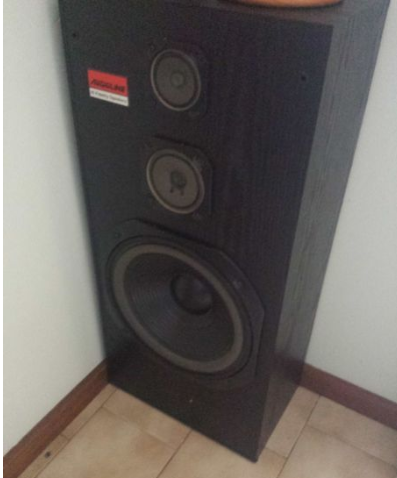
Audioline Australian made speakers

This post is a tribute to, and a documentation of the various models of Audioline brand speaker. There is no other mention of Audioline speakers on the internet so I thought I would do a brief write up.

Audioline speakers, were manufactured in Melbourne Australia by a company called BD Imports. They also made similar speakers under the Linear Design name.  BD Imports was run by a fellow named Wayne Douglas. (From the Douglas hifi stores) This company currently make the Jensen branded speakers sold in JB Hi-Fi.

BD Imports does not appear to make any speakers under the Audioline brand name anymore.

The Audioline brand name is now entirely owned by JB Hifi and currently makes car amplifiers and some PA speakers.  I am unclear if the Audioline brand was always owned by JB Hi-Fi or if BD imports previously had some ownership of the name? I will try to find out.

This blog post covers the Australian made speakers manufactured by BD imports, between the late 1970's and 1990's. It does not cover the newer Audioline car amps or PA speakers. As a side note, I did in the past own an Audioline car amplifier and found that it sounded very clear, and was extremely reliable.

I like Audioline because they are made and designed in Australia. (using imported speaker drivers)
They are usually big, and have a minimum of 10" bass drivers.
They usually have a wide frequency response. No matter which model, they all seem to genuinely  play low to about 30Hz. They also give a "big" sound that I like.

I guess Audioline was Australia's version of Cerwin Vega, and according to the "About us" section of Jensen speakers website, even some Cerwin Vega speakers were designed in Australia, presumably by Wayne Douglas? -If anyone can confirm this, let me know....
I also like Cerwin Vega.

In order to honestly review Audioline speakers I have to mention the negative aspects as well as the good.
The cabinets on some models use thin wood.
The crossovers use very cheap components and also only use 6dB/octave crossovers. (some people actually like the sound of 6dB/octave crossovers better than 12dB) Some bass drivers on some models run full range!
The plastic surrounds around the drivers on some models cause dispersions and reflections and negatively affect the sound. Thankfully the plastic surrounds can be removed and this improves the sound dramatically.

The good aspect is that overall these are a very good sounding speaker, they are able to deliver deep clear tonal bass, and dynamics like only a big speaker can. Sonic detail is very good. The presentation of the mid and high frequencies is not as refined as more expensive speakers (over $2000), but I would describe this as being more like an error of omission rather than something which is glaringly wrong with the sound. There does not appear to be any major peaks or dips in the mid/high region which negatively affect the sound. Vocals sound clean and clear. The sound quality of these speakers is well above anything else at their price point.

For better sound - remove the plastic surrounds from around the drivers, and power them with a quality amplifier and source.  

When searching the internet I found a post on a forum discussing the sound of Audioline - this is what one guy thinks of the sound.

I often get asked which amp to use for powering Audioline speakers so please see my post here which is an edited version of a reply that I sent to a nice gentleman who wrote me an email asking me about amplifiers.


Pictures of various models below: 

                                                  AL-3210

Also sold as the Linear Design TS-1000 shown below:


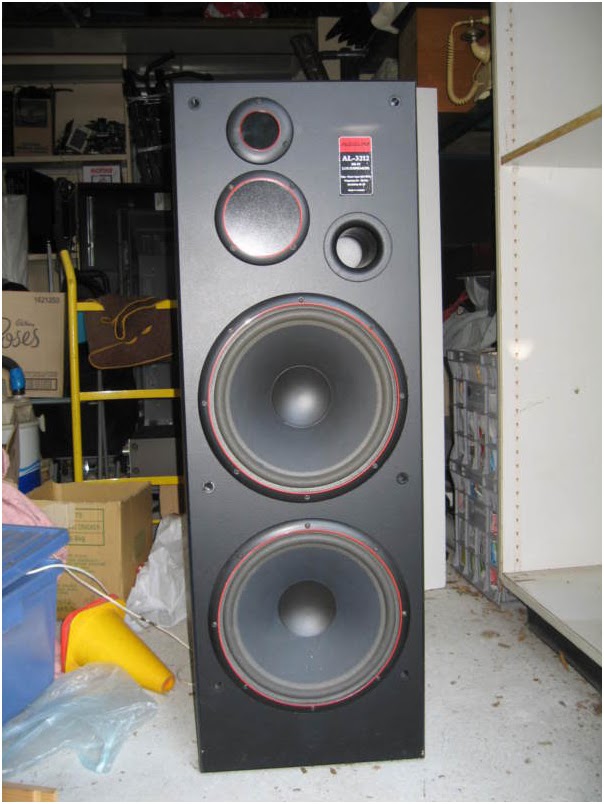
AL-3212
Size W - 36cm, H - 105 cm, Depth - 38 cm

AL-1400

AL-1200
    Dual 12" woofers
    5" Mid-range
    Dome tweeter
    Dimensions: 41" (H) x 13.5" (W) x 15" (D)
    Max power: 200Watts
    Response: 26 - 20 Khz
    Sensitivity: 95 dB   

AL-1200 version 1

AL-1200 version 2. - Note the different tweeter
AL-1200 version 2


AL-1000
A couple of notes regarding this speaker. There are two versions of this model that I know of.
One of them is an earlier version. It uses two 12" (30cm) bass drivers. The later model also known as the AL-1000 has two 10" bass drivers. Sometimes you cant tell from looking at a photo with the covers on which one has the 12" drivers. The distinguishing feature is the sticker on front of the speaker. The 12" says 2x30cm on the sticker. They also look very different with the covers off.

12 inch cabinet dimensions:
Measuring 97cm H x 40cm W x 36cm D

Woofer: 2 x 30cm (12")
Mid: 11cm
Tweeter 1" dome
Maximum Power = 170Watts

10 inch cabinet dimensions:
 Size: 96cm H x 30cm W x 33cm D

Woofer 2 x 10"
Mid 11cm
Tweeter 1" dome
Maximum Power = 170 Watts


This AL-1000 above has two 10" bass drivers.
The AL-1000 above has two 12" bass drivers.


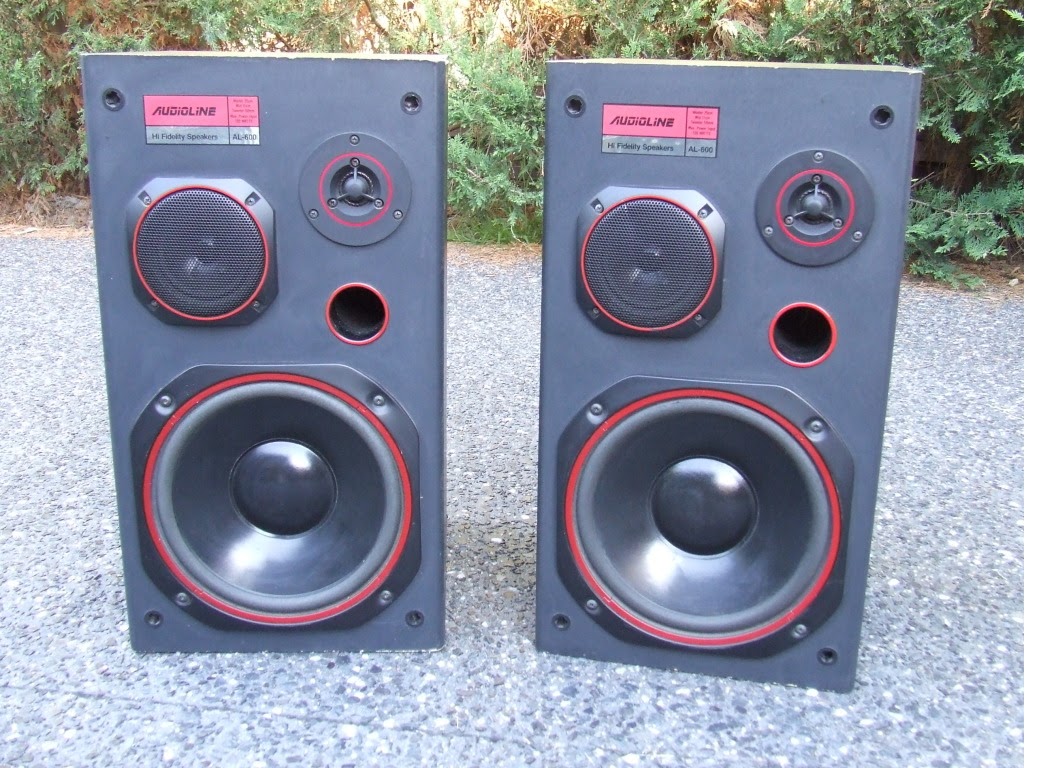
AL-600
Dimensions: 60 x 30 x 25cm
Weight: 8 kg each
Power Handling: 120w (Peak)
Impedance: 8 ohms
Sensitivity: 94dB

AL-310

Unknown Model with 12" woofers
320mm x 230mm x 550mm 
This looks to be similar to the "Audioline by Foster" except this model uses a sealed cabinet
AL-132
800H X 400W X 310D
8- OHMS, 80WATTS

AL-12


                                                                         VX-800


This one has a more upmarket "look" to it. But I think it only has two 8" drivers which would make this the smallest bass driver that Audioline used - but even so, this is still bigger than most other "tower" speakers.

 Here is a picture of the VX-800 with dark wood veneer. I prefer the lighter colour.

                                                                       VX-400


                                                                      Audioline 807B

This model also seems to use 8" bass drivers. You can also see that Audioline also made centre speakers for home theatre use. It seems they were sometimes sold as a "package".


                                                                        AL-800

                 965mm high, 300mm wide & about 270mm deep.

The AL-800 only goes to 34Hz. It also only goes up to 18Khz. This one is interesting because it has a paper cone tweeter.

 How cute is this?
             The AL-250 mini bookshelf / rear surround speakers.


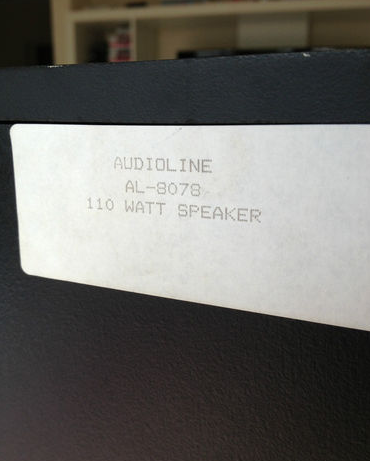
AL-8078
 Height 97cm W 24cm D33


AL  8018

H97 W24  D33 
(same as the 8078 above but with different drivers)


Audioline 232
No information

Audioline by Foster
no information


Unknown Audioline
Has 12" Woofers. Paper mid-range and tweeters.


Unknown Audioline.
No information. Note the wood grain finish.
I suspect this is from the late 1970's or early 80's.


Audioline AL-200
90 Watt
Dimensions 36cm high  x 23cm wide

AL-360


The last picture is of the AL-4415 because who doesn't like a 15" bass driver?
I know I do :-)

              The AL-4415 has a 15" woofer, two mids and a tweeter.
Dimensions:
Height - 850mm
Width - 435mm
Depth - 390mm